
Parallel Universe: Pazzo is a series of (so far) five Radium Age Science Fiction podcasts produced by HiLobrow and recorded at Pazzo Books, in Boston, Mass.
At the bottom of this page, you’ll find an introduction to Radium Age science fiction by Joshua Glenn.
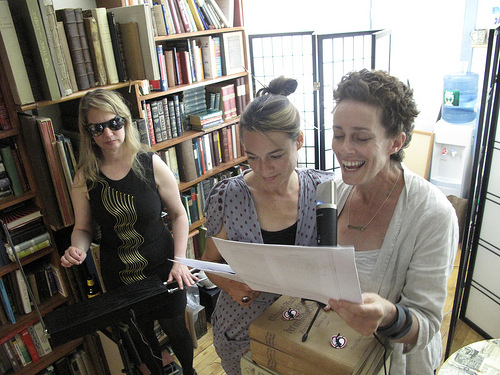
The first half of “Parallel Universe: Pazzo — 5/ECO-CATASTROPHE” includes excerpts from Fred MacIsaac’s The Hothouse World (1931), Edmond Hamilton’s The Polar Doom (1928), George Allen England’s Darkness and Dawn (1914), and Gabriel De Tarde’s Underground Man (1905 in English). Click on these links in order to hear the individual readings.
LISTEN TO/DOWNLOAD the first half of this episode.
Parallel Universe: Pazzo 5/Eco-Catastrophe (Part 1) by HILOBROW
Alas, the second half of this episode was somehow destroyed during the recording process! It included excerpts from S. Fowler Wright’s Deluge (1927), Andre Maurois’ The Next Chapter: The War Against the Moon (1928 in English), J.J. Connington’s Nordenholt’s Million (1923), and also “Sound Thinking,” an oil-spill micro-fiction by HiLo contest winner A.E. Smith.
TITLE: “Parallel Universe: Pazzo — 5/ECO-CATASTROPHE”
DATE: June 11, 2010
HOST & PRODUCER: Joshua Glenn
READERS: Tor Aarestad, Ryan Mulcahy, Tom Nealon, Peggy Nelson, James Parker, Kristin Parker, Ingrid Schorr
THEREMIN: Peggy Nelson
SPONSOR: Pazzo Used, Rare & Out-of-Print Books (Tom Nealon, proprietor)
PUBLISHER: HiLobrow.com
READ MORE about RADIUM AGE ECO-CATASTROPHES. | READ THE WINNING ENTRY in our “Oil Spill” micro-fiction contest. | READ THE HONORABLE MENTIONS in our “Oil Spill” micro-fiction contest.
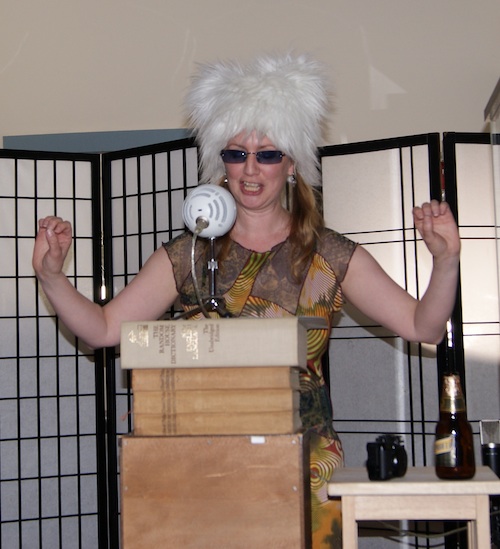
The first half of “Parallel Universe: Pazzo — 4/TELEPATHY” includes readings from the following Radium Age, telepathy-themed science fictions: Otis Adelbert Kline’s The Planet of Peril, Homer Eon Flint’s The Devolutionist, H. Rider Haggard’s When the World Shook, A. Merritt’s The Face in the Abyss. PLUS, one pre-Radium Age reading: Edward Bulwer-Lytton’s The Coming Race. Click on these links to hear the individual stories.
LISTEN TO/DOWNLOAD EPISODE 4, PART 1:
PARALLEL UNIVERSE: PAZZO, 4TH EPISODE, PART 1 by HILOBROW
The second half of “Parallel Universe: Pazzo — 4/TELEPATHY” includes readings from the following Radium Age, telepathy-themed science fictions: Edwin Lester Arnold’s Lieut. Gullivar Jones: His Vacation, Garrett P. Serviss’ A Columbus of Space, Edgar Rice Burroughs’ A Princess of Mars, and Olaf Stapledon’s Last Men in London. PLUS: HILOBROW’s Matthew Battles read an original, contest-winning microfiction by Rachel Ellis Adams. Click on these links to hear the individual stories.
LISTEN TO/DOWNLOAD EPISODE 4, PART 2:
PARALLEL UNIVERSE: PAZZO, 4TH EPISODE, PART 2 by HILOBROW
TITLE: “Parallel Universe: Pazzo — 4/TELEPATHY”
HOST & PRODUCER: Joshua Glenn*
READERS: Tor Aarestad, Anindita Basu Sempere, Matthew Battles*, Ryan Mulcahy, Tom Nealon, Peggy Nelson, James Parker, Kristin Parker, Susan Roe (* HiLobrow.com’s editors)
THEREMIN: Peggy Nelson
THEME MUSIC: Sampled from Elvis Presley’s “Always on My Mind” and Glenn Campbell’s “If You Could Read My Mind”
SPONSOR: Pazzo Used, Rare & Out-of-Print Books (Tom and Brian Nealon, proprietors)
PUBLISHER: HiLobrow.com
READ MORE about RADIUM AGE TELEPATHY FICTION. | READ THE WINNING ENTRY in our “Telepathy” micro-fiction contest. | READ THE HONORABLE MENTIONS in our “Telepathy” micro-fiction contest.
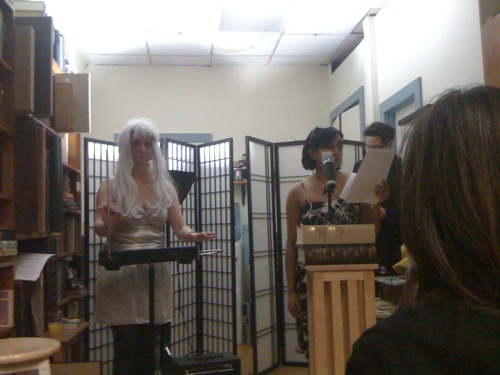
The first half of our third episode features readings from Jack London’s The Scarlet Plague (1915), Philip Wylie and Edwin Balmer’s When Worlds Collide (1933), Edgar Rice Burroughs’ The Moon Men (1926), and Karel Čapek’s The Absolute at Large (1922).
LISTEN TO/DOWNLOAD EPISODE 3, PART 1:
Pazzo-apocalypse-1 by HILOBROW
The second half of our third episode features readings from M.P. Shiel’s The Purple Cloud (1901), Arthur Conan Doyle’s The Poison Belt (1913), William Hope Hodgson’s The Night Land (1912), and Olaf Stapledon’s Last and First Men (1930). We also recorded the winning entry, by Timothy Raymond, in our recent micro-fiction contest.
LISTEN TO/DOWNLOAD EPISODE 3, PART 2:
Pazzo-apocalypse-2 by HILOBROW
TITLE: “Parallel Universe: Pazzo — 3/APOCALYPSES”
DATE: April 2, 2010
HOST & PRODUCER: Joshua Glenn*
READERS: Tor Aarestad, Anindita Basu Sempere, Matthew Battles*, Brian Nealon, Tom Nealon, Peggy Nelson, James Parker, Kristin Parker (* HiLobrow.com’s editors)
THEREMIN/WIGS: Peggy Nelson
THEME MUSIC: Sampled from Frank Smith’s “Apocalypse Circa Now”
SPONSOR: Pazzo Used, Rare & Out-of-Print Books (Tom and Brian Nealon, proprietors)
PUBLISHER: HiLobrow.com
READ MORE about RADIUM AGE APOCALYPSES. | READ THE WINNING ENTRY in our “Radium Age Apocalypses” micro-fiction contest.
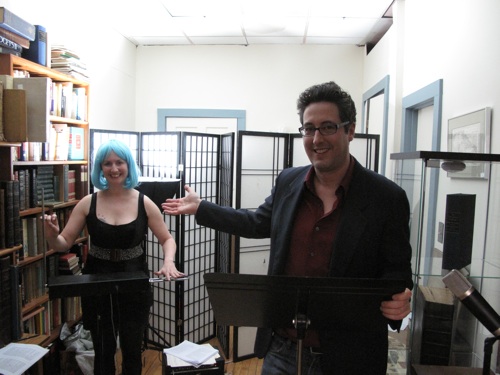
The first half of Episode 2 features readings from the following Radium Age supermen tales: J.D. Beresford’s The Hampdenshire Wonder, Olaf Stapledon’s Sirius, John Taine’s Seeds of Life, Erle Cox’s Out of the Silence, and Philip Wylie’s Gladiator.
LISTEN TO (OR DOWNLOAD) EPISODE TWO, PART 1:
Parallel Universe: Pazzo (episode 2, part 1) by HILOBROW
The second half of Episode 2 features readings from the following Radium Age supermen tales: Edmond Hamilton’s “The Man Who Evolved,” Alfred Jarry’s The Supermale, and George Bernard Shaw’s Back to Methuselah. We also recorded the winning story — by Charles Pappas — in our first micro-fiction contest.
LISTEN TO (OR DOWNLOAD) EPISODE TWO, PART 2:
“Parallel Universe: Pazzo” (Episode 2, Part 2) by HILOBROW
TITLE: “Parallel Universe: Pazzo — 2/SUPERMEN”
DATE: February 26, 2010
HOST & PRODUCER: Joshua Glenn*
READERS: Tor Aarestad, Matthew Battles*, Joanne McNeil, Ryan Mulcahy, Brian Nealon, Tom Nealon, Peggy Nelson, James Parker (* HiLobrow.com’s editors)
THEREMIN/WIGS: Peggy Nelson
THEME MUSIC: Sampled from David Bowie’s “Oh! You Pretty Things”
SPONSOR: Pazzo Used, Rare & Out-of-Print Books (Tom and Brian Nealon, proprietors)
PUBLISHER: HiLobrow.com
READ MORE about RADIUM AGE SUPERMEN. | READ THE WINNING ENTRY in our “Radium Age Supermen” micro-fiction contest. | READ THE HONORABLE MENTIONS in our “Radium Age Supermen” micro-fiction contest.
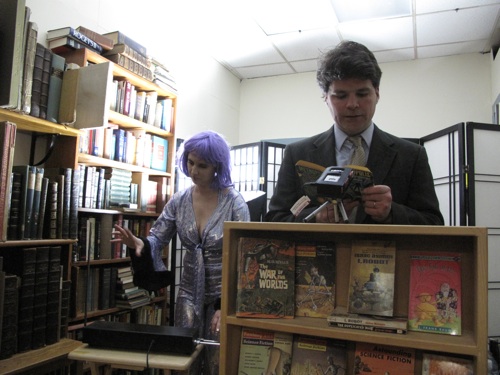
Our podcast’s inaugural episode is devoted to Radium Age mechanical and quasi-organic humanoids — which is to say, to ROBOTS. Introduction to the 1st episode:
The term “robot” was introduced in Karel Capek’s 1921 play R.U.R.: Rossum’s Universal Robots. The Czechoslovakian play, from which the TV show Dollhouse took the name of its sinister corporation, is set in a [probably American] factory that mass-produces biological humanoids designed for blue-collar occupations. The term “robot” from the Czech word for “serf labor.” These days, however, we’d call Capek’s creatures “androids,” not robots. However, [Radium Age] science fiction is replete with our kind of robot: electricity-, steam-, and clockwork-powered machine-men who — like the Industrial Revolution from which they sprang — promised either to free us from the burden of labor… or else destroy or enslave us.
LISTEN TO (OR DOWNLOAD) EPISODE ONE:
Parallel Universe: Pazzo (1) ROBOTS by HILOBROW
LISTEN TO (OR DOWNLOAD) AN EXCERPT FROM EPISODE ONE:
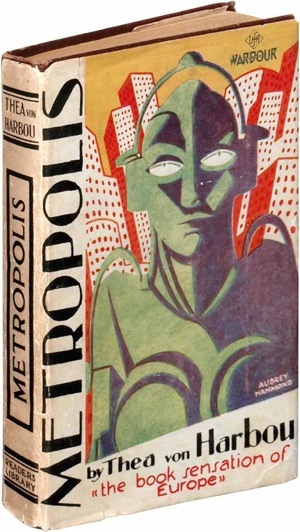
Matthew Battles reads: “The Jameson Satellite” (1931), by Neil R. Jones | Tom Nealon reads: “The Last Poet and the Robots” (1934), by A. Merritt | Tor Aarestad reads: “Moxon’s Master” (1909), by Ambrose Bierce | Ryan Mulcahy reads: Metropolis (1926), by Thea von Harbou | James Parker reads: “The Dancing Partner” (1893), by Jerome K. Jerome | Brian Nealon reads: Ozma of Oz (1907), by L. Frank Baum
TITLE: “Parallel Universe: Pazzo — 1/ROBOTS”
DATE: January 15, 2010
HOST & PRODUCER: Joshua Glenn*
READERS: Tor Aarestad, Matthew Battles*, Ryan Mulcahy, Brian Nealon, Tom Nealon, James Parker
THEREMIN/WIGS: Peggy Nelson (* HiLobrow.com’s editors)
THEME MUSIC: Sampled from DJ Spooky’s “Scanner/William S. Burroughs”
SPONSOR: Pazzo Used, Rare & Out-of-Print Books (Tom and Brian Nealon, proprietors)
PUBLISHER: HiLobrow.com
READ MORE about RADIUM AGE ROBOTS.
I’ve named the years 1904-33 the “Radium Age” of science fiction because the phenomenon of radioactivity — the discovery that matter is neither solid nor still and is, at least in part, a state of energy, constantly in movement — is a timely and fitting metaphor for the first decades of the 20th century, “vertigo years” during which old scientific, religious, political, and social certainties were shattered.
Why those dates, in particular? Not merely because the Curies won the Nobel Prize for their discovery of radium in ’03, while Marie Curie died (from radiation-induced leukaemia) in ’34. By Glenn’s reckoning, the 19th-century era of Wellsian “scientific romances” ended between ’00 and ’03, while the so-called Golden Age of SF began between ’34 and ’37. The intervening three decades gave us American and European SF visionaries like Olaf Stapledon, William Hope Hodgson, Sax Rohmer, Karel Čapek, Hugo Gernsback, E.E. Smith, H.P. Lovecraft, Charlotte Perkins Gilman, Yevgeny Zamyatin, Rudyard Kipling, Jack London, E.M. Forster, Arthur Conan Doyle, David Lindsay, David H. Keller, John Taine, Jack Williamson, S. Fowler Wright, F. Scott Fitzgerald, Gustave Le Rouge, A. Merritt, Murray Leinster, Jean de La Hire, Maurice Renard, Garrett P. Serviss, and Philip Wylie. Not to mention Edgar Rice Burroughs and Aldous Huxley.
Science fiction’s so-called Golden Age began in the late 1930s, when John Campbell became editor of Astounding Stories and, eschewing space operas featuring babes in silver bikinis menaced by Bug-Eyed Monsters, instead began to solicit literate, analytical, and socially conscious “speculative fiction” from Isaac Asimov, Ray Bradbury, Arthur C. Clarke, and other writers we now consider the best of the best. As a result, science fiction writers who got their start in the post-H.G. Wells and Jules Verne era — roughly, between 1900 and 1935 — became personae non gratae. In his introduction to a 1974 collection titled Before the Golden Age, Asimov himself would note that although it may have possessed a certain exuberant vigor, in general pre-Golden Age [Radium Age] science fiction “seems, to anyone who has experienced the Campbell Revolution, to be clumsy, primitive, naive” — in a word, immature.
In the context of Cold War-era culture, the rhetoric of “maturity” cannot be taken as simply literary; it is also crypto-political. For example: at a 1952 Partisan Review symposium, Reinhold Niebuhr spoke for his fellow liberals and neocons when he rejected the widespread utopianism of the 1920s-30s as “an adolescent embarrassment.” The notion of “maturity” haunts the memoirs of anti-utopian intellectuals who’d been active at midcentury. If we no longer read Radium Age science fiction, it’s not because the era’s prose is adolescent in comparison with that of Golden Age science fiction authors. (Despite the assurances of influential SF critics like Kingsley Amis, it’s not true!) It’s because during the Cold War, we were encouraged to believe that every utopian vision is a totalitarian dystopia waiting to happen; this was a relentless message of much Golden-Age science fiction. But for earlier authors, whatever their politics, the medium of science fiction itself expressed a faith — one which HiLobrow.com shares — that another world is possible.
So “Parallel Universe: Pazzo” is a utopian (or, at least, an anti-anti-utopian) program, in one or more senses of “program.” We’re on a mission: to explore strange new paradigms; to seek out pre-1935 Lost Worlds, Supermen, Eco-Catastrophes, Telepaths, and Robots; to boldly podcast where no one has podcasted before.
PS: I also introduced Radium Age science fiction at io9.