
Marsden Hartley
By:
January 4, 2013
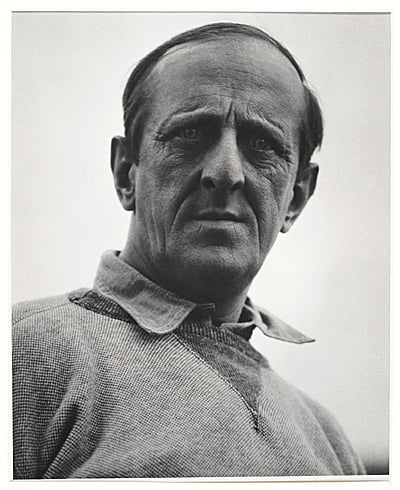
“Gloxinias, fuschias, begonias/All are crisping with terror, curling and crisping/with plum blue terror,” wrote MARSDEN HARTLEY (1877–1943), in “Cobwebs and Ratholes,” one of the great American painter’s many strange and remarkable poems. Though Hartley’s artistic stature is reflected in numerous monographs (I’m especially fond of Patricia McDonnell’s Marsden Hartley: American Modern), his substantial literary achievement is less well-known. He was first published — after jejune meddling by editor Harriett Monroe — in Poetry in July 1918; five years later, Robert McAlmon’s Contact Press brought forth Hartley’s Twenty-Five Poems. Like his life in general, Hartley’s verse is restless in style. Still, two literary influences stand out. Though too young to meet Walt Whitman himself, Hartley was an acolyte of the bard, painting his 328 Mickle Street, Camden, home and forming an ardent yet somewhat elusive relationship with Whitman’s amanuensis Horace Traubel. Jonathan Williams, who published their 1906–1915 correspondence as Heart’s Gate, observed “We see M.H. very early in his great and difficult passage as an artist in an America where men’s feelings were inarticulate and often furtive.” Hartley and Hart Crane first met in New York where, years apart, they shared the same Brooklyn address, 110 Columbia Heights. The two grew closer abroad, in Marseilles and Mexico City, where Hartley remained when Crane left for Vera Cruz and his subsequent death plunge from the S.S. Orizaba. In Eight Bells Folly: Memorial to Hart Crane, oil on canvas, and “Un Recuerdo —Hermano —Hart Crane R.I.P.”, an elegy, Hartley remembers his drowned friend’s bones.
***
On his or her birthday, HiLobrow irregularly pays tribute to one of our high-, low-, no-, or hilobrow heroes. Also born this date: C.L.R. James.
READ MORE about members of the Psychonaut Generation (1874–1883).