
Shocking Blocking (40)
By:
November 29, 2012
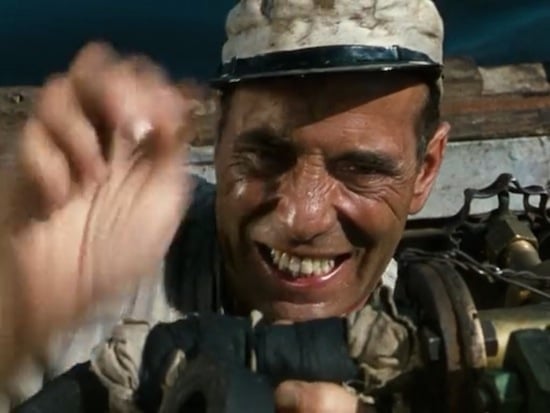
John Huston’s The African Queen is easier to love than to like. It’s easy to love because it’s a throwback to pre-Forties, pre-hardboiled Hollywood. Compared with previous Huston-Bogart team-ups, however, the movie’s sentimentality, its dearth of cynicism, makes it hard to like. Early on, in those scenes in which lowbrow riverboat tramp Charlie (Humphrey Bogart) becomes more civilized as highbrow missionary Rose (Katharine Hepburn) becomes less so, The African Queen is downright allegorical — a Pilgrim’s Progress in which the destination is not the Celestial City but Middlebrow! However, if we regard the movie not as a romantic comedy, but as a propaganda film — the genre on which Huston cut his teeth — of sorts, we might decide that we’re being asked to consider the problem of how to survive not war, but peace, with one’s humanity intact. A hardboiled Bogart-esque carapace will no longer suffice; in fact, after the Forties it will be a burden. The blocking of scenes like this one suggests that a postwar hero might be an unheroic-appearing “minor man” (to quote Philip K. Dick, who started writing around the time The African Queen appeared), “in all his hasty, sweaty strength.” I do like that idea.
An occasional series analyzing some of the author’s favorite moments in the positioning or movement of actors in a movie.
THIRTIES (1934–1943): It Happened One Night (1934) | The Man Who Knew Too Much (1934) | The Guv’nor (1935) | The 39 Steps (1935) | Young and Innocent (1937) | The Lady Vanishes (1938) | Mr. Smith Goes to Washington (1939) | The Big Sleep (1939) | The Little Princess (1939) | Gone With the Wind (1939) | His Girl Friday (1940)
FORTIES (1944–1953): The Diary of a Chambermaid (1946) | The Asphalt Jungle (1950) | The African Queen (1951)
FIFTIES (1954–1963): A Bucket of Blood (1959) | Beach Party (1963)
SIXTIES (1964–1973): For Those Who Think Young (1964) | Thunderball (1965) | Clambake (1967) | Bonnie and Clyde (1967) | Madigan (1968) | Wild in the Streets (1968) | Barbarella (1968) | Harold and Maude (1971) | The Mack (1973) | The Long Goodbye (1973)
SEVENTIES (1974–1983): Les Valseuses (1974) | Eraserhead (1976) | The Bad News Bears (1976) | Breaking Away (1979) | Rock’n’Roll High School (1979) | Escape from Alcatraz (1979) | Apocalypse Now (1979) | Caddyshack (1980) | Stripes (1981) | Blade Runner (1982) | Tender Mercies (1983) | Monty Python’s The Meaning of Life (1983)
EIGHTIES (1984–1993): Repo Man (1984) | Buckaroo Banzai (1984) | Raising Arizona (1987) | RoboCop (1987) | Goodfellas (1990) | Candyman (1992) | Dazed and Confused (1993) |
NINETIES (1994–2003): Pulp Fiction (1994) | The Fifth Element (1997)
OUGHTS (2004–13): Nacho Libre (2006) | District 9 (2009)
READ MORE essays by Joshua Glenn, originally published in: THE BAFFLER | BOSTON GLOBE IDEAS | BRAINIAC | CABINET | FEED | HERMENAUT | HILOBROW | HILOBROW: GENERATIONS | HILOBROW: RADIUM AGE SCIENCE FICTION | HILOBROW: SHOCKING BLOCKING | THE IDLER | IO9 | N+1 | NEW YORK TIMES BOOK REVIEW | SEMIONAUT | SLATE
Joshua Glenn’s books include UNBORED: THE ESSENTIAL FIELD GUIDE TO SERIOUS FUN (with Elizabeth Foy Larsen); and SIGNIFICANT OBJECTS: 100 EXTRAORDINARY STORIES ABOUT ORDINARY THINGS (with Rob Walker).