
Kirk Your Enthusiasm (10)
By:
August 10, 2012
Tenth in a series of posts, each one analyzing a single Captain Kirk scene from the Star Trek canon.
Captain Camelot | “Return to Tomorrow” | Star Trek: The Original Series | Season 2, Episode 20 | 1968
There were two things close to a religious figure in my mid-to-post-1960s, lapsed-Catholic & secular-Jewish household: John F. Kennedy and William Shatner. Shatner got his celestial-wiseman status from his role as Captain Kirk; and Kirk got his philosopher-prince status from JFK.
It can’t be a coincidence that, soon after America lost its King Arthur, a hero in the heavens with almost his same initials was crossing the galaxy and brokering American-style gunboat peace to other planets. And then there was Kirk’s poetic musings; his open, secure acknowledgement of his fallibility; his skirt-chasing bonhomie — and even his windswept haircut.
Kennedy helped integrate America after widening the White House doors for Irish Catholics; Kirk, a Canadian Jew in real life playing an Anglo-Saxon paragon on television, brought a multicultural crew onto primetime (with at least one member, Nichelle Nichols, urged to stay on the show by Martin Luther King). Maybe the only way to bring this equality about in 1966-69 was in fantasy, in some far future, and on some other planet. Kirk took us through the stars toward which Kennedy first pushed us.
Kennedy was a martyr, and Kirk our once-and-future-king figure. Rakishly witty, ready to stare down despots, putting his comrades’ safety ahead of his own and governing (sometimes) by his crew’s informed consent. These were the qualities we projected onto JFK and JTK, from press conferences to banter with Spock, from P.T. 109 to Klingon torture. And from the president’s deliberative style to the cases Kirk would make for his space-federation’s daring ventures.
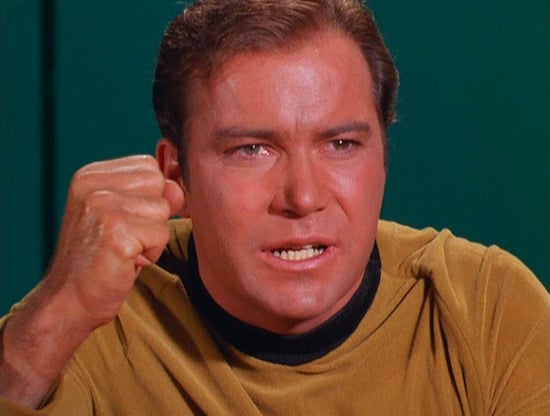
In the “Return to Tomorrow” episode of the original series, Kirk gets several Enterprise officers into a conference room to give an impromptu kitchen-table speech about how risk is the essence and purpose of their voyage. This is delivered after several superior alien intelligences are found in glass globes on a devastated planet, asking to inhabit some crewmembers’ brains while the advanced beings — survivors of a once great, too arrogant hi-tech society — build android-body vessels for themselves.
Kirk argues for the moral lessons and scientific leaps this arrangement offers, and the human frontiers it can help the Enterprise cross. For all his posturing at many points in the series, this speech was the essence of an exhortation left echoing in the wake of Kennedy’s absence: To leave behind the worlds we know and become not lost but better.
2012: KIRK YOUR ENTHUSIASM (Captain Kirk scenes): Dafna Pleban: Justice or vengeance? | Mark Kingwell : Kirk teaches his drill thrall to kiss | Nick Abadzis: “KHAAAAAN!” | Stephen Burt: “No kill I” | Greg Rowland: Kirk browbeats NOMAD | Zack Handlen: Kirk’s eulogy for Spock| Peggy Nelson: The joke is on Kirk | Kevin Church: Kirk vs. Decker | Enrique Ramirez: Good Kirk vs. Evil Kirk | Adam McGovern: Captain Camelot | Flourish Klink: Koon-ut-kal-if-fee | David Smay: Federation exceptionalism | Amanda LaPergola: Wizard fight | Steve Schneider: A million things you can’t have | Joshua Glenn: Debating in a vacuum | Kelly Jean Fitzsimmons: Klingon diplomacy | Trav S.D.: “We… the PEOPLE” | Matthew Battles: Brinksmanship on the brink | Annie Nocenti: Captain Smirk | Ian W. Hill: Sisko meets Kirk | Gabby Nicasio: Noninterference policy | Peter Bebergal: Kirk’s countdown | Matt Glaser: Kirk’s ghost | Joe Alterio: Watching Kirk vs. Gorn | Annalee Newitz: How Spock wins
ALSO ON HILOBROW Peggy Nelson on William Shatner as HiLo Hero | Greg Rowland on Leonard Nimoy as HiLo Hero | Peggy Nelson on William Shatner in Incubus | Matthew Battles on enlarging the Trek fanfic canon | Radium Age Supermen | Radium Age Robots | Radium Age Apocalypses | Radium Age Telepaths | Radium Age Eco-Catastrophes | Radium Age Cover Art (1) | SF’s Best Year Ever: 1912
2014: KERN YOUR ENTHUSIASM (typefaces): Matthew Battles on ALDINE ITALIC | Adam McGovern on DATA 70 | Sherri Wasserman on TORONTO SUBWAY | Sarah Werner on JOHNSTON’S “HAMLET” | Douglas Wolk on TODD KLONE | Mark Kingwell on GILL SANS | Joe Alterio on AKZIDENZ-GROTESK | Suzanne Fischer on CALIFORNIA BRAILLE | Gary Panter on SHE’S NOT THERE | Deb Chachra on FAUX DEVANAGARI | Peggy Nelson on FUTURA | Tom Nealon on JENSON’S ROMAN | Rob Walker on SAVANNAH SIGN | Tony Leone on TRADE GOTHIC BOLD CONDENSED NO. 20 | Chika Azuma on KUMON WORKSHEET | Chris Spurgeon on ELECTRONIC DISPLAY | Amanda French on DIPLOMA REGULAR | Steve Price on SCREAM QUEEN | Alissa Walker on CHICAGO | Helene Silverman on CHINESE SHIPPING BOX | Tim Spencer on SHATTER | Jessamyn West on COMIC SANS | Whitney Trettien on WILKINS’S REAL CHARACTER | Cintra Wilson on HERMÈS vs. HOTDOG | Jacob Covey on GOTHAM.
2013: HERC YOUR ENTHUSIASM (old-school hip hop tracks): Luc Sante on “Spoonin’ Rap” | Dallas Penn on “Rapper’s Delight” | Werner Von Wallenrod on “Rappin’ Blow” | DJ Frane on “The Incredible Fulk” | Paul Devlin on “The Adventures of Super Rhyme” | Phil Dyess-Nugent on “That’s the Joint” | Adam McGovern on “Freedom” | David Abrams on “Rapture” | Andrew Hultkrans on “The New Rap Language” | Tim Carmody on “Jazzy Sensation (Bronx Version)” | Drew Huge on “Can I Get a Soul Clap” | Oliver Wang on “The Adventures of Grandmaster Flash on the Wheels of Steel” | Douglas Wolk on “Making Cash Money” | Adrienne Crew on “The Message” | Dart Adams on “Pak Jam” | Alex Belth on “Buffalo Gals” | Joshua Glenn on “Ya Mama” | Phil Freeman on “No Sell Out” | Nate Patrin on “Death Mix Live, Pt. 2” | Brian Berger on “White Lines (Don’t Do It)” | Cosmo Baker on “Here We Go (Live at the Funhouse)” | Colleen Werthmann on “Rockit” | Roy Christopher on “The Coldest Rap” | Dan Reines on “The Dream Team is in the House” | Franklin Bruno on The Lockers.
2011: KIRB YOUR ENTHUSIASM (Jack Kirby panels): Douglas Rushkoff on THE ETERNALS | John Hilgart on BLACK MAGIC | Gary Panter on DEMON | Dan Nadel on OMAC | Deb Chachra on CAPTAIN AMERICA | Mark Frauenfelder on KAMANDI | Jason Grote on MACHINE MAN | Ben Greenman on SANDMAN | Annie Nocenti on THE X-MEN | Greg Rowland on THE FANTASTIC FOUR | Joshua Glenn on TALES TO ASTONISH | Lynn Peril on YOUNG LOVE | Jim Shepard on STRANGE TALES | David Smay on MISTER MIRACLE | Joe Alterio on BLACK PANTHER | Sean Howe on THOR | Mark Newgarden on JIMMY OLSEN | Dean Haspiel on DEVIL DINOSAUR | Matthew Specktor on THE AVENGERS | Terese Svoboda on TALES OF SUSPENSE | Matthew Wells on THE NEW GODS | Toni Schlesinger on REAL CLUE | Josh Kramer on THE FOREVER PEOPLE | Glen David Gold on JOURNEY INTO MYSTERY | Douglas Wolk on 2001: A SPACE ODYSSEY | MORE EXEGETICAL COMMENTARIES: Joshua Glenn on Kirby’s Radium Age Sci-Fi Influences | Chris Lanier on Kirby vs. Kubrick | Scott Edelman recalls when the FF walked among us | Adam McGovern is haunted by a panel from THE NEW GODS | Matt Seneca studies the sensuality of Kirby’s women | Btoom! Rob Steibel settles the Jack Kirby vs. Stan Lee question | Galactus Lives! Rob Steibel analyzes a single Kirby panel in six posts | Danny Fingeroth figgers out The Thing | Adam McGovern on four decades (so far) of Kirby’s “Fourth World” mythos | Jack Kirby: Anti-Fascist Pipe Smoker