
Jack Williamson
By:
April 29, 2012
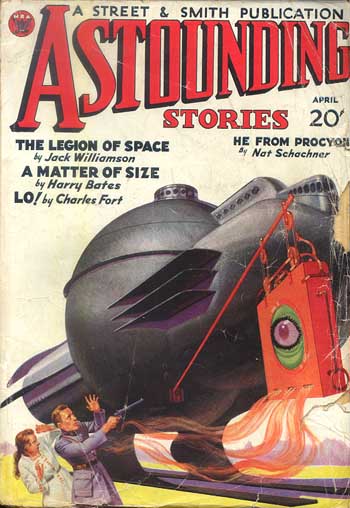
Science-fiction’s so-called Golden Age (1934-63) was spearheaded by writers who remain well-known (e.g., Heinlein, Asimov, Van Vogt), writers who’ve fallen into obscurity (Fredric Brown, C.L. Moore, Eando Binder), and by betwixt-and-between figures like JACK WILLIAMSON (1908-2006), who was important enough to be named the Dean of Science Fiction — but only after Heinlein died. Williamson, whose first story (“The Metal Man”) appeared in a 1928 issue of Amazing Stories, helped introduce to the Golden Age canon certain memes first developed during sf’s Radium Age (1904-33). These include everything from terraforming (1942’s “Collision Orbit”) to antimatter (1949’s Seetee Shock), to genetic engineering (1951’s Dragon’s Island). Williamson also introduced readers, via Darker Than You Think (1940), to the persuasive notion that werewolves invented rational skepticism in order to make humankind stop believing in werewolves; if this meme never caught on, blame the werewolves’ ongoing cultural hegemony. Williamson’s most important contribution may be to science fiction’s space opera subgenre: His Legion of Space series, which stars warriors Jay Kala and Hal Samdu, the Purple Hall Empire renegade John Ulnar, and super-lockpicker Giles “The Ghost” Habibula, is a key link in the chain connecting the space opera of, for example, E.E. “Doc” Smith to that of, say, Iain M. Banks.
***
On his or her birthday, HiLobrow irregularly pays tribute to one of our high-, low-, no-, or hilobrow heroes. Also born this date: Maya Deren.
READ MORE about members of the Partisan Generation (1904-13).
MORE RADIUM AGE SCI FI ON HILOBROW: HiLoBooks homepage! | What is Radium Age science fiction? |Radium Age 100: 100 Best Science Fiction Novels from 1904–33 | Radium Age Supermen | Radium Age Robots | Radium Age Apocalypses | Radium Age Telepaths | Radium Age Eco-Catastrophes | Radium Age Cover Art (1) | SF’s Best Year Ever: 1912 | Radium Age Science Fiction Poetry | Enter Highbrowism | Bathybius! Primordial ooze in Radium Age sf | War and Peace Games (H.G. Wells’s training manuals for supermen) | Radium Age: Context series | J.D. Beresford | Algernon Blackwood | Edgar Rice Burroughs | Karel Čapek | Buster Crabbe | August Derleth | Arthur Conan Doyle | Hugo Gernsback | Charlotte Perkins Gilman | Cicely Hamilton | Hermann Hesse | William Hope Hodgson | Aldous Huxley | Inez Haynes Irwin | Alfred Jarry | Jack Kirby (Radium Age sf’s influence on) | Murray Leinster | Gustave Le Rouge | Gaston Leroux | David Lindsay | Jack London | H.P. Lovecraft | A. Merritt | Maureen O’Sullivan | Sax Rohmer | Paul Scheerbart | Upton Sinclair | Clark Ashton Smith | E.E. “Doc” Smith | Olaf Stapledon | John Taine | H.G. Wells | Jack Williamson | Stanisław Ignacy Witkiewicz | S. Fowler Wright | Philip Gordon Wylie | Yevgeny Zamyatin
GOLDEN-AGE SCI-FI at HILOBROW: Golden Age Sci-Fi: 75 Best Novels of 1934–1963 | Robert Heinlein | Karel Capek | William Burroughs | E.E. “Doc” Smith | Clifford D. Simak | H.P. Lovecraft | Olaf Stapledon | Philip K. Dick | Jack Williamson | George Orwell | Boris Vian | Bernard Wolfe | J.G. Ballard | Jorge Luis Borges |Poul Anderson | Walter M. Miller, Jr. | Murray Leinster | Kurt Vonnegut | Stanislaw Lem | Alfred Bester | Isaac Asimov | Ray Bradbury | Madeleine L’Engle | Arthur C. Clarke | PLUS: Jack Kirby’s Golden Age and New Wave science fiction comics.