Shocking Blocking (22)
By: Joshua Glenn | Categories: Spectacles

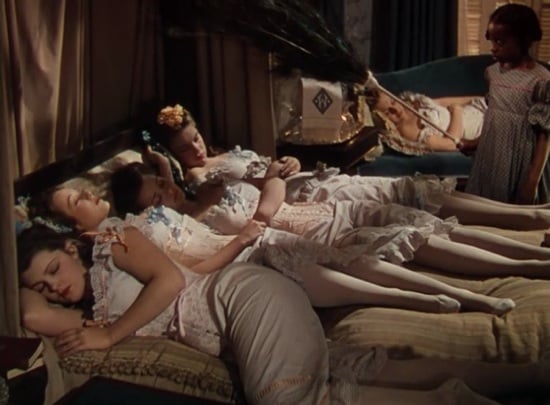
I don’t care what the American Film Institute says: despite Clark Gable’s (and Hattie McDaniel’s) charm, Gone With the Wind is a middlebrow, boring, Southern-fried mess. But I do admire the blocking in this scene—which is set at Twelve Oaks, during a barbecue party. The assembled belles are taking a rather cramped siesta, while the menfolk downstairs argue about the coming war. The idealistic, romantic plantationers insist that the war will be short and glorious; Rhett Butler (Gable) suspects otherwise. In fact, the war will be devastating and grisly. Bodies will be stacked together on battlefields like so much cordwood… or like so many napping belles.

***

An occasional series analyzing some of the author’s favorite moments in the positioning or movement of actors in a movie.

SIMILAR HILOBROW SERIES: ANGUSONICS — the solos of Angus Young | DE CONDIMENTIS — a world-secret-historical take on ketchup, mustard, relish, and more | DOUBLE EXPOSURE — the stratagems of Middlebrow | FITTING SHOES — famous literary footwear | KIRB YOUR ENTHUSIASM — 25 Jack Kirby panels | PLUPERFECT PDA — time-traveling smartphones! | SKRULLICISM

Share

MORE POSTS by

Joshua Glenn is a Boston-based writer, publisher, and cultural semiologist-for-hire. He does business as KING MIXER, LLC. He is coauthor and/or co-editor of TAKING THINGS SERIOUSLY, THE IDLER'S GLOSSARY, THE WAGE SLAVE'S GLOSSARY, the object-oriented story collection SIGNIFICANT OBJECTS, and the kids' field guide to life UNBORED. He is co-founder of the websites HILOBROW and SEMIONAUT; and co-founder of the science fiction imprint HILOBOOKS. He produced and co-designed the iPhone app KER-PUNCH. He manages a secretive online community known as THE HERMENAUTIC CIRCLE. In the '00s, Glenn was an editor, columnist, blogger (BRAINIAC), and new media producer at the BOSTON GLOBE. In the '90s, among other things, he published the philosophy/pop culture zine HERMENAUT; co-produced the DIY website and early online social network TRIPOD; and was an editor at UTNE READER.

6 Comments to “Shocking Blocking (22)”

  1. John Bonaccorsi, Philadelphia, PA says:

    You needn’t disparage Gone with the Wind as middlebrow; it’s merely popular fiction. (And yes, the American Film Institute might be expected to recognize that.)

    From Edmund Pearson’s 1929 monograph Dime Novels; or, Following an old trail in popular literature:

    “Popular literature, and its enjoyment, is seldom the concern of the scholarly critic, until three or four centuries have passed. It is a social phenomenon rather than a matter of artistic achievement.” (First paragraph, Section III)

    “Anybody with the slightest knowledge of the wide appeal of popular fiction will not need to be told that the reading of dime novels was not exclusively confined to boys, or to rude and uncultivated men. Stories of this type have always been enjoyed by everybody, except a very small class of persons.” (Fourth paragraph, Section V)

    The monograph may be read at http://gaslight.mtroyal.ca/dimex01.htm

  2. Joshua Glenn says:

    Thanks for the comment, John. I’m not among the small class of persons who doesn’t enjoy popular fiction; I’m among the small class of persons who distinguishes between homemade, eccentric lowbrow culture (which is charming) and the low-middlebrow culture industry’s commodified, quaint, cutesy output (which is creepy). Dime novels are charming; Gone with the Wind — the movie — is creepy.

  3. John Bonaccorsi, Philadelphia, PA says:

    I appreciate your reply, Joshua. For the record, I personally am among those who don’t enjoy popular literature (though I wasn’t always).

    Maybe the problem is that I don’t know the meaning of “middlebrow.” If I were asked to identify a middlebrow, boring, Southern-fried mess, I’d probably say, “I don’t know. That Ken Burns thing about the Civil War?” (Haven’t seen it, actually. Five seconds or so of it here and there were enough.)

    You might be right that Gone with the Wind — the movie — is commodified, quaint, and cutesy — but is it conspicuously so among the movies on AFI’s list of greats? Maybe it is — but I’m still not associating it with the term “middlebrow,” which, in my uncertain understanding, means “lets me know I are a thinker.”

  4. John Bonaccorsi, Philadelphia, PA says:

    Correction: “lets me know I are elevated.”

  5. Joshua Glenn says:

    Thanks for another thoughtful reply, John. You are absolutely right to be confused — because (a) journalists and intellectuals have promoted a quite false notion that middlebrow is some sort of bridge between highbrow and lowbrow culture, when in fact it only serves to drive them apart; and (b) we’ve been developing our own construct about this sort of thing, here at HiLobrow, but have only explained it intermittently — for various reasons. (The INFO link at top right of the sidebar provides a peek into our construct, but only a peek.) We distinguish — as some others have — between High Middlebrow (which lets you know you am elevated) and Low Middlebrow (which is literary but not too difficult, and contains overt messages of well-being). All of this is a work in progress.

    AFI’s list generally is disappointing — I wasn’t really trying to comment on the list here. Just taking issue with their notion that GWTW is one of the 10 best movies of all time.

  6. John Bonaccorsi, Philadelphia, PA says:

    Thank you, too, Joshua, for replying again — and for steering me to the INFO link, which I had read but which I’ll now keep in mind for guidance to HiLobrow’s view.

Leave a Reply