
Kirb Your Enthusiasm (24)
By:
March 8, 2011
Twenty-fourth in a series of posts, each one analyzing a single panel from a Jack Kirby-drawn comic book.
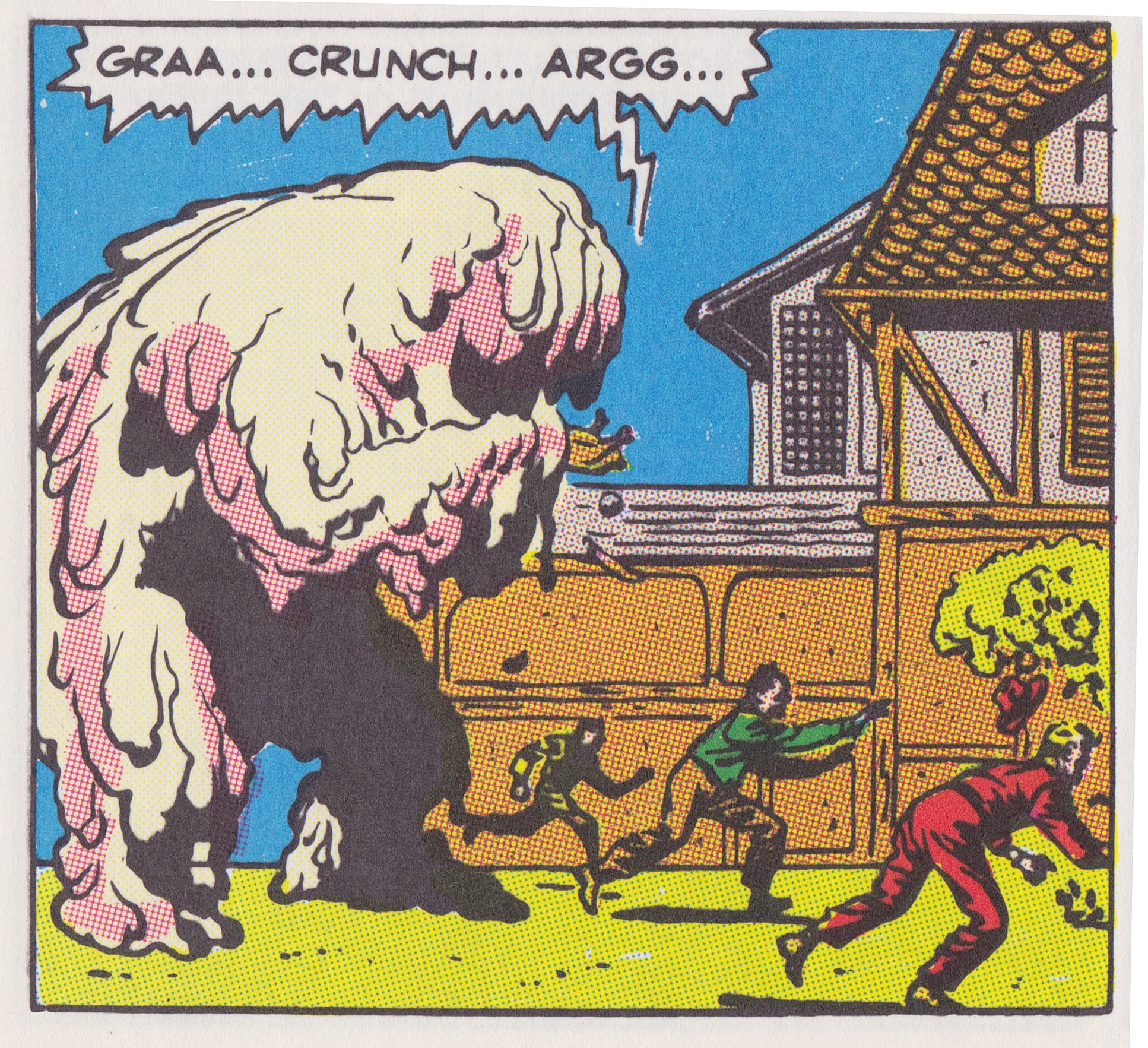
If the Id were a statue covered in magic paint and if the Id lived in a remote Balkan village, and if the Id were approximately 30 feet tall, this is what it would look like. Oh, sure there are long-term desires — conquering the world, enslaving the populace, banishing your enemies to other dimensions — who of us hasn’t daydreamed and even, in my case at least, made contingency plans in case I succeed? But that’s the trap of having dreams: there’s always a “when” before you can relax, and that prevents happiness in the present day. Desire sets the wheel of Karma in motion, and the suspension of fulfillment between now (you know, the sheer bloody joy of being able to hypnotize earthlings with a single glance) and then (domination of the galaxy) is where you get bitten in the ass. A puny human tricks you into sleeping for eternity, or it turns out you’re a sentient tree and they don’t have termites on your home planet, or a cowardly-seeming scientist uses a radio he just invented to call your parents to use a giant grappling hook to take you back to your star system, weeping all the way. No, you can’t win, you never do. Death or the moral universe takes you to task. Until then, the way of the sage is work without effort, the way to do is to be. That’s how I strive to live.
And yet, I don’t really live that way. The Id isn’t going away, pal. And you know what? The Id can’t stand the Tao. They’re enemies, and right here, in this panel from Journey into Mystery #72 (September 1961): look who’s losing! Screw you, enemy of desire! I, The Glob, crave food, FOOD!, and thus I am now eating a turkey. I’ll be back with you in a sec.
This is one of the rarest things — a Kirby panel in which desire is actually fulfilled. That kind of thing is dangerous and doing it yourself, as an artist, is one of those 10-for-difficulty triple axel double gainers of a problem. How do you suspend narrative, even for a moment, without it feeling slack? I haven’t yet figured out fiction’s accompanying solution to comics’ easy answer: have Kirby draw it. The Glob isn’t attacking here. He isn’t lurching, isn’t dynamic, isn’t threatening, no propelling forward. But somehow, it’s not a quiet scene (even when Kirby drew lovers in afterglow, they looked like they were ready to pistolwhip each other at the click of a gat). But nonetheless here is a signal moment of narrative disc braking. There is literally no reason for this panel in the story; Lee or Lieber didn’t even have dialogue for it. Sure, there’s more to say: we can learn a lot about perspective from the three villagers running away, and sure, we can speculate whether Kirby kept drawing monsters in front of overtimbered houses because of his awful German winter of Infantry experience, and sure, someone braver than myself will wonder just a little bit about why such an Id-like creature looks as if he’s fleeing the set of a bukkake film. But really I’m mostly interested in this rare moment of rest. Well done, Kirby; well done, Glob.
It won’t last for him, you know. Later (SPOILER ALERT) magic turpentine will thin the magic paint, conquest plans are dismantled, there will be agony, hopelessness, the usual. It ends for him as it ends for us. The Glob, like all of us, all of us who aren’t Marvel superheroes, dies. Forever.
But for now, the Glob is simply — rampage on hold — eating a turkey. Because it makes him happy. As it does me.
2011: KIRB YOUR ENTHUSIASM (Jack Kirby panels): Douglas Rushkoff on THE ETERNALS | John Hilgart on BLACK MAGIC | Gary Panter on DEMON | Dan Nadel on OMAC | Deb Chachra on CAPTAIN AMERICA | Mark Frauenfelder on KAMANDI | Jason Grote on MACHINE MAN | Ben Greenman on SANDMAN | Annie Nocenti on THE X-MEN | Greg Rowland on THE FANTASTIC FOUR | Joshua Glenn on TALES TO ASTONISH | Lynn Peril on YOUNG LOVE | Jim Shepard on STRANGE TALES | David Smay on MISTER MIRACLE | Joe Alterio on BLACK PANTHER | Sean Howe on THOR | Mark Newgarden on JIMMY OLSEN | Dean Haspiel on DEVIL DINOSAUR | Matthew Specktor on THE AVENGERS | Terese Svoboda on TALES OF SUSPENSE | Matthew Wells on THE NEW GODS | Toni Schlesinger on REAL CLUE | Josh Kramer on THE FOREVER PEOPLE | Glen David Gold on JOURNEY INTO MYSTERY | Douglas Wolk on 2001: A SPACE ODYSSEY | MORE EXEGETICAL COMMENTARIES: Joshua Glenn on Kirby’s Radium Age Sci-Fi Influences | Chris Lanier on Kirby vs. Kubrick | Scott Edelman recalls when the FF walked among us | Adam McGovern is haunted by a panel from THE NEW GODS | Matt Seneca studies the sensuality of Kirby’s women | Btoom! Rob Steibel settles the Jack Kirby vs. Stan Lee question | Galactus Lives! Rob Steibel analyzes a single Kirby panel in six posts | Danny Fingeroth figgers out The Thing | Adam McGovern on four decades (so far) of Kirby’s “Fourth World” mythos | Jack Kirby: Anti-Fascist Pipe Smoker
ALSO ON HILOBROW: Joe Alterio’s Cablegate Comix | HiLobrow posts about comics and cartoonists | HiLobrow posts about science fiction | The New Gods generation
2014: KERN YOUR ENTHUSIASM (typefaces): Matthew Battles on ALDINE ITALIC | Adam McGovern on DATA 70 | Sherri Wasserman on TORONTO SUBWAY | Sarah Werner on JOHNSTON’S “HAMLET” | Douglas Wolk on TODD KLONE | Mark Kingwell on GILL SANS | Joe Alterio on AKZIDENZ-GROTESK | Suzanne Fischer on CALIFORNIA BRAILLE | Gary Panter on SHE’S NOT THERE | Deb Chachra on FAUX DEVANAGARI | Peggy Nelson on FUTURA | Tom Nealon on JENSON’S ROMAN | Rob Walker on SAVANNAH SIGN | Tony Leone on TRADE GOTHIC BOLD CONDENSED NO. 20 | Chika Azuma on KUMON WORKSHEET | Chris Spurgeon on ELECTRONIC DISPLAY | Amanda French on DIPLOMA REGULAR | Steve Price on SCREAM QUEEN | Alissa Walker on CHICAGO | Helene Silverman on CHINESE SHIPPING BOX | Tim Spencer on SHATTER | Jessamyn West on COMIC SANS | Whitney Trettien on WILKINS’S REAL CHARACTER | Cintra Wilson on HERMÈS vs. HOTDOG | Jacob Covey on GOTHAM.
2013: HERC YOUR ENTHUSIASM (old-school hip hop tracks): Luc Sante on “Spoonin’ Rap” | Dallas Penn on “Rapper’s Delight” | Werner Von Wallenrod on “Rappin’ Blow” | DJ Frane on “The Incredible Fulk” | Paul Devlin on “The Adventures of Super Rhyme” | Phil Dyess-Nugent on “That’s the Joint” | Adam McGovern on “Freedom” | David Abrams on “Rapture” | Andrew Hultkrans on “The New Rap Language” | Tim Carmody on “Jazzy Sensation (Bronx Version)” | Drew Huge on “Can I Get a Soul Clap” | Oliver Wang on “The Adventures of Grandmaster Flash on the Wheels of Steel” | Douglas Wolk on “Making Cash Money” | Adrienne Crew on “The Message” | Dart Adams on “Pak Jam” | Alex Belth on “Buffalo Gals” | Joshua Glenn on “Ya Mama” | Phil Freeman on “No Sell Out” | Nate Patrin on “Death Mix Live, Pt. 2” | Brian Berger on “White Lines (Don’t Do It)” | Cosmo Baker on “Here We Go (Live at the Funhouse)” | Colleen Werthmann on “Rockit” | Roy Christopher on “The Coldest Rap” | Dan Reines on “The Dream Team is in the House” | Franklin Bruno on The Lockers.
2012: KIRK YOUR ENTHUSIASM (Captain Kirk scenes): Dafna Pleban: Justice or vengeance? | Mark Kingwell : Kirk teaches his drill thrall to kiss | Nick Abadzis: “KHAAAAAN!” | Stephen Burt: “No kill I” | Greg Rowland: Kirk browbeats NOMAD | Zack Handlen: Kirk’s eulogy for Spock| Peggy Nelson: The joke is on Kirk | Kevin Church: Kirk vs. Decker | Enrique Ramirez: Good Kirk vs. Evil Kirk | Adam McGovern: Captain Camelot | Flourish Klink: Koon-ut-kal-if-fee | David Smay: Federation exceptionalism | Amanda LaPergola: Wizard fight | Steve Schneider: A million things you can’t have | Joshua Glenn: Debating in a vacuum | Kelly Jean Fitzsimmons: Klingon diplomacy | Trav S.D.: “We… the PEOPLE” | Matthew Battles: Brinksmanship on the brink | Annie Nocenti: Captain Smirk | Ian W. Hill: Sisko meets Kirk | Gabby Nicasio: Noninterference policy | Peter Bebergal: Kirk’s countdown | Matt Glaser: Kirk’s ghost | Joe Alterio: Watching Kirk vs. Gorn | Annalee Newitz: How Spock wins