
Kirb Your Enthusiasm (7)
By:
February 24, 2011
Seventh in a series of posts, each one analyzing a single panel from a Jack Kirby-drawn comic book.
As a kid, I found Kirby’s ’70s comics garish, frightening, overindulgent — belonging more to forbidden “adult” comics like The Fabulous Furry Freak Brothers or The Savage Sword of Conan than to the familiar worlds of DC and Marvel. That all changed when, as a pre-teen, I found entire runs of Kamandi and Machine Man to be had for a few dollars at the flea markets and used bookstores of suburban New Jersey. (As an aside: in one issue of Kamandi the titular hero does battle in a post-apocalyptic department store that is identical in every way to the Englishtown Flea Market). Collectors had snapped up Kirby’s more valuable Fourth World, and Golden and Silver Age Marvel creations, but although I’d once dismissed ’70s Kirby as something akin to primitivism (because my eye had been trained by the Marvel house style and/or by cartoon-ier DC artists like Curt Swan or Ramona Fradon), I now found myself entranced.
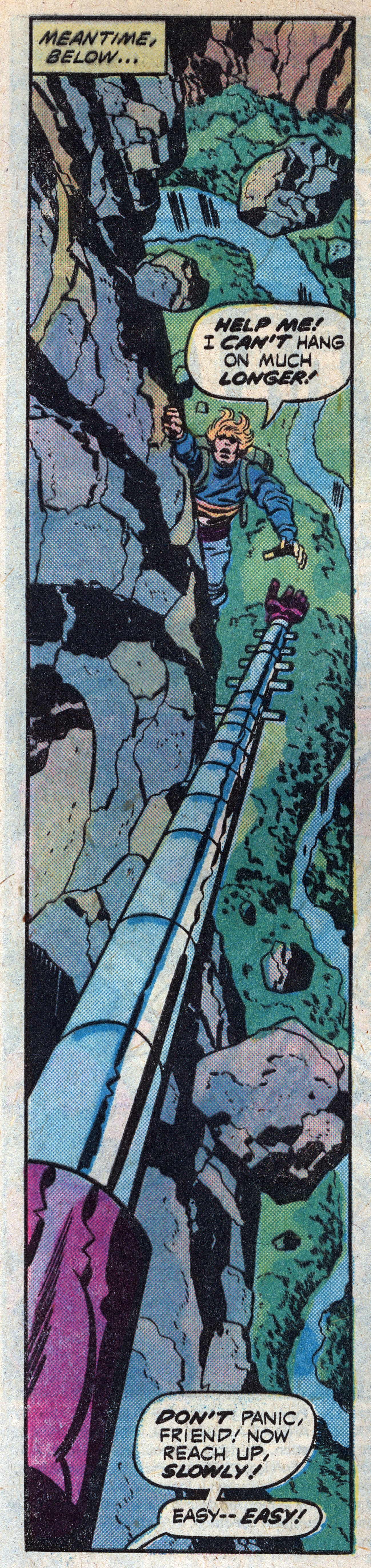
Machine Man has a strange pedigree — although the character has been showcased in some truly brilliant sf comics, he’s a fairly boilerplate character (the self-aware, emotional robot) who spun out of Kirby’s adaptation of Kubrick’s/Clarke’s 2001, one of the weirder licensed comics ever to have existed. Unlike, say, the extended Star Wars universe, 2001 didn’t leave much room for spinoffs, so Marvel gave us the further adventures of that trippy superevolved space baby and those Australopithecines who were visited by the monolith, until finally we arrived seven issues later at a superhero who was a little bit like HAL 9000. The above panel, from the second page of Machine Man #1 (April 1978), shows a fairly typical superhero rescue… but the plot details aren’t important.
Kirby here shows himself to be a subtler and more confident artist than even the most skilled of his peers, who presented iconic superheroes flexing in battle-ready poses on page after page; instead, he represents his (brand new!) hero via a single body part, an extendable arm that turns into a ladder. (This brainstorm would be aped, years later, by the creators of the animated children’s cartoon Inspector Gadget). With the picture’s unusual vertical length and dizzying perspective, Kirby puts himself in conversation with great artists and engineers: like Filippo Brunelleschi, who invented forced perspective in1425; or the Austrian Joseph Puchberger, who invented the first panoramic camera in 1843, cranking Daguerreotype plates 19 to 24 inches long. Finally, the panel also evokes mid-period Hitchcock films like Vertigo (1958) and North by Northwest (1959), giving the reader the sickening sense of falling from a great height. Even in this supposedly lesser work, Kirby is a supreme storyteller, a master of composition, and a sui generis genius of the dynamics of cartooning.
2011: KIRB YOUR ENTHUSIASM (Jack Kirby panels): Douglas Rushkoff on THE ETERNALS | John Hilgart on BLACK MAGIC | Gary Panter on DEMON | Dan Nadel on OMAC | Deb Chachra on CAPTAIN AMERICA | Mark Frauenfelder on KAMANDI | Jason Grote on MACHINE MAN | Ben Greenman on SANDMAN | Annie Nocenti on THE X-MEN | Greg Rowland on THE FANTASTIC FOUR | Joshua Glenn on TALES TO ASTONISH | Lynn Peril on YOUNG LOVE | Jim Shepard on STRANGE TALES | David Smay on MISTER MIRACLE | Joe Alterio on BLACK PANTHER | Sean Howe on THOR | Mark Newgarden on JIMMY OLSEN | Dean Haspiel on DEVIL DINOSAUR | Matthew Specktor on THE AVENGERS | Terese Svoboda on TALES OF SUSPENSE | Matthew Wells on THE NEW GODS | Toni Schlesinger on REAL CLUE | Josh Kramer on THE FOREVER PEOPLE | Glen David Gold on JOURNEY INTO MYSTERY | Douglas Wolk on 2001: A SPACE ODYSSEY | MORE EXEGETICAL COMMENTARIES: Joshua Glenn on Kirby’s Radium Age Sci-Fi Influences | Chris Lanier on Kirby vs. Kubrick | Scott Edelman recalls when the FF walked among us | Adam McGovern is haunted by a panel from THE NEW GODS | Matt Seneca studies the sensuality of Kirby’s women | Btoom! Rob Steibel settles the Jack Kirby vs. Stan Lee question | Galactus Lives! Rob Steibel analyzes a single Kirby panel in six posts | Danny Fingeroth figgers out The Thing | Adam McGovern on four decades (so far) of Kirby’s “Fourth World” mythos | Jack Kirby: Anti-Fascist Pipe Smoker
ALSO ON HILOBROW: Joe Alterio’s Cablegate Comix | HiLobrow posts about comics and cartoonists | HiLobrow posts about science fiction | The New Gods generation
2014: KERN YOUR ENTHUSIASM (typefaces): Matthew Battles on ALDINE ITALIC | Adam McGovern on DATA 70 | Sherri Wasserman on TORONTO SUBWAY | Sarah Werner on JOHNSTON’S “HAMLET” | Douglas Wolk on TODD KLONE | Mark Kingwell on GILL SANS | Joe Alterio on AKZIDENZ-GROTESK | Suzanne Fischer on CALIFORNIA BRAILLE | Gary Panter on SHE’S NOT THERE | Deb Chachra on FAUX DEVANAGARI | Peggy Nelson on FUTURA | Tom Nealon on JENSON’S ROMAN | Rob Walker on SAVANNAH SIGN | Tony Leone on TRADE GOTHIC BOLD CONDENSED NO. 20 | Chika Azuma on KUMON WORKSHEET | Chris Spurgeon on ELECTRONIC DISPLAY | Amanda French on DIPLOMA REGULAR | Steve Price on SCREAM QUEEN | Alissa Walker on CHICAGO | Helene Silverman on CHINESE SHIPPING BOX | Tim Spencer on SHATTER | Jessamyn West on COMIC SANS | Whitney Trettien on WILKINS’S REAL CHARACTER | Cintra Wilson on HERMÈS vs. HOTDOG | Jacob Covey on GOTHAM.
2013: HERC YOUR ENTHUSIASM (old-school hip hop tracks): Luc Sante on “Spoonin’ Rap” | Dallas Penn on “Rapper’s Delight” | Werner Von Wallenrod on “Rappin’ Blow” | DJ Frane on “The Incredible Fulk” | Paul Devlin on “The Adventures of Super Rhyme” | Phil Dyess-Nugent on “That’s the Joint” | Adam McGovern on “Freedom” | David Abrams on “Rapture” | Andrew Hultkrans on “The New Rap Language” | Tim Carmody on “Jazzy Sensation (Bronx Version)” | Drew Huge on “Can I Get a Soul Clap” | Oliver Wang on “The Adventures of Grandmaster Flash on the Wheels of Steel” | Douglas Wolk on “Making Cash Money” | Adrienne Crew on “The Message” | Dart Adams on “Pak Jam” | Alex Belth on “Buffalo Gals” | Joshua Glenn on “Ya Mama” | Phil Freeman on “No Sell Out” | Nate Patrin on “Death Mix Live, Pt. 2” | Brian Berger on “White Lines (Don’t Do It)” | Cosmo Baker on “Here We Go (Live at the Funhouse)” | Colleen Werthmann on “Rockit” | Roy Christopher on “The Coldest Rap” | Dan Reines on “The Dream Team is in the House” | Franklin Bruno on The Lockers.
2012: KIRK YOUR ENTHUSIASM (Captain Kirk scenes): Dafna Pleban: Justice or vengeance? | Mark Kingwell : Kirk teaches his drill thrall to kiss | Nick Abadzis: “KHAAAAAN!” | Stephen Burt: “No kill I” | Greg Rowland: Kirk browbeats NOMAD | Zack Handlen: Kirk’s eulogy for Spock| Peggy Nelson: The joke is on Kirk | Kevin Church: Kirk vs. Decker | Enrique Ramirez: Good Kirk vs. Evil Kirk | Adam McGovern: Captain Camelot | Flourish Klink: Koon-ut-kal-if-fee | David Smay: Federation exceptionalism | Amanda LaPergola: Wizard fight | Steve Schneider: A million things you can’t have | Joshua Glenn: Debating in a vacuum | Kelly Jean Fitzsimmons: Klingon diplomacy | Trav S.D.: “We… the PEOPLE” | Matthew Battles: Brinksmanship on the brink | Annie Nocenti: Captain Smirk | Ian W. Hill: Sisko meets Kirk | Gabby Nicasio: Noninterference policy | Peter Bebergal: Kirk’s countdown | Matt Glaser: Kirk’s ghost | Joe Alterio: Watching Kirk vs. Gorn | Annalee Newitz: How Spock wins