Put Down that Web!
By: Matthew Battles | Categories: Browbeating

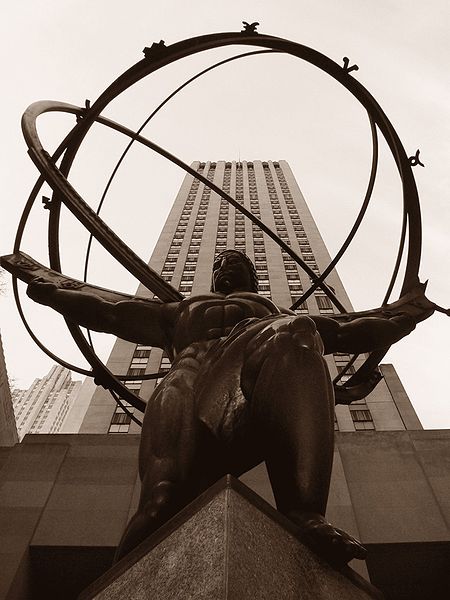
Atlas Sepia<em>, by Kurt Christensen</em>

Atlas Sepia, by Kurt Christensen

A COLLEGE WHERE I do a bit of teaching just sent me an email announcing the formation of a “social media working group” whose job it is to “research, suggest, and implement strategies and best practices” and “organize a system for maintaining (the college’s) social media presence and content.”

Higher education, like the mainstream media, is frankly desperate to extend their dominion in the social networking space. Like their corporate peers, they’ve been eager to colonize the flourishing Internet at each phase of its development, and now is no exception. It’s hardly novel of me to say that along the way they’re killing everything that makes networked communication a worthwhile cultural force.

At first blush, it seems as if they’re right to fear the evolution of the Internet. At its ever-adapting edge, its energies and structures are fundamentally opposed to the hierarchized world of middlebrow knowledge and opinion that is the dark matter of the institutional, incorporated way of life. That’s why it’s so dispiriting that to date these shifting technologies have proven amenable to middlebrow domestication at every turn—and the social media are proving no different.

I’m no advocate of censorship; these media should be used in every possible way. But when I use Twitter and other social media, I’m seeking a dialogue with individual minds, not corporate interests. Friending or following major-media news shows, accredited colleges, and corporate philanthropies is not dialogue in any true sense of the word.

In a thriving networked culture, it should be possible not merely to complement but to replace institutions and corporations with commons-native constellations of intelligence. The mainstream media quakes before the ever-multiplying range of news-gathering alternatives. In the intellectual world, the Infinite Summer—a massively distributed endeavor to collectively read and discuss the late novelist David Foster Wallace’s magnum opus Infinite Jest—is proving the power of social media to build loosely-structured networks of brains to replace the medieval legacy of colleges, faculties, and curricula.

But the middlebrow institutions—Titans of modernity’s prior imperium—keep getting in the way. Do not friend them; do not follow.

  • Share/Bookmark

About the author: Matthew Battles

Matthew Battles, Hilobrow's cofounder, writes about language, history, and technology for many publications. He's also the author of Library, An Unquiet History.

Read more from Matthew Battles (178 posts) on Hilobrow.

5 Comments to “Put Down that Web!”

  1. Josh Glenn says:

    Yes! Though sometimes our friends themselves turn out to be avatars of middlebrow institutionalism…

    Is the answer private, invite-only, endlessly customizable versions of Facebook, MySpace, maybe even private versions of the Internet? Intersecting spheres, and spheres within spheres? This would more closely model the way our real-world social networks operate, anyway. Of course, once we all start doing this, we’ll immediately mourn the lost public sphere, the agora in which we all once mixed and mingled.

  2. Matthew Battles says:

    ouch! Our avatars, ourselves… All I’m really saying is, maybe choose not to follow these things. Let others follow them. They’re not the agora—they’re lobster traps, Skinner boxes, content silos out on the edge of town.

  3. otolythe says:

    Larry Harvey has talked about theme camps at Burning Man as private social spaces that are still open to ‘the outside,’ a negotiation between private and public that does foster the good features of the agora. So don’t necessarily need to retreat into gated communities, virtual or otherwise.

    But it is absolutely essential to avoid these things: institutions, corporations, or otherwise, that broadcast, even if they’re not selling something. Because the very structure of broadcasting precludes real relationship, and not only perverts the notion of friend/ing, but prevents any new real thing from developing! Sucks all the air out.

  4. Joshua Glenn says:

    Or did the agora always have a version of major-media news shows, accredited colleges, and corporate philanthropies trying to “friend” you? Not that this means the phenomenon is OK — maybe it just means that the agora was never as good as we like to think it was.

    The architectural theorist Ernest Pascucci wrote a couple of good articles for Hermenaut on this topic. Here’s the only one that’s online, in which he suggests that the midcentury liberal certainty “that space is the absolute precondition for authentic public life, and that those lives which are mediated by television are somehow less authentic and less public than they should be” may be a shibboleth.

    Again, this is not to say that it’s perfectly OK for corporations or middlebrow institutions to try to friend us on Facebook and get us to follow their Twitter feeds. I don’t like that! It’s just to suggest that there may not have ever been a public sphere untainted by this sort of thing.

  5. Matthew Battles says:

    True—and I don’t mean to imply that there was some Golden-Age agora untainted by the influence of the powerful. Only that if you want to stay free of such influence, you have to use the social media very carefully.

Leave a Reply